The Balcony
The screening room is for showing a film you own to the people you choose, without giving them a copy. The Balcony is the other problem: a film neither of you owns, two subscriptions, two countries, and nothing to protect — only the difficulty of pressing play at the same moment.
No file moves in either room. That is the only thing the two have in common, and it is not a coincidence.
The question everyone else skips
Every watch-party tool assumes you can both see the same film. Across a border that is frequently false, and false silently — you find out when they say “it’s not here”. Catalogues are licensed country by country, so the same title can be on Netflix for you, on Prime for them, and nowhere at all for a third person. None of those three look any different until somebody tries to press play.
So the answer is not yes or no. It is one of four, and telling them apart is the product.
Yes
Same service, both countries, and a player we can drive.
Different services
Each of you can watch it. Never together — it is on one service for you and another for them.
Not in the catalogue
It does not exist in one of your countries at all. No amount of syncing fixes a licence.
No adapter yet
Both of you have it, on a service we cannot drive. A queue item, not a dead end — and worth saying out loud rather than filing under unavailable.
The person comes first
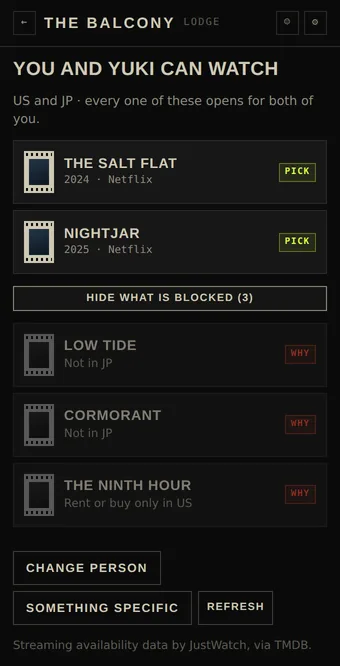
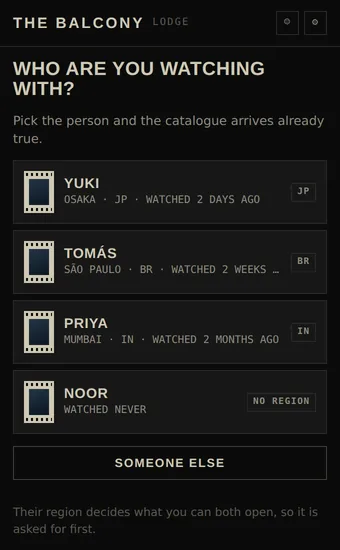
You choose who you are watching with before you choose what. Their region is the input the catalogue needs, so asking for it afterwards means offering someone a film and then taking it away. Say you are in Austin: pick a friend in Osaka and the list is what Osaka and Austin can both open. Pick São Paulo and it is a different list.
The catalogue that arrives is already true. Nothing in it can disappoint either of you later, because everything that could has already been filtered out — and is still there, one tap away, with its reason attached.
A person whose region you do not know yet is a normal state, not an error. Guessing it from a phone number or an email domain is wrong often enough to matter, and being wrong here means proposing something they cannot open. So the invitation can go out with no title in it at all: they confirm where they are, and then you both pick. Searching for something specific still works — the difference is that the verdict is on the row before you click it.
One clock, not two
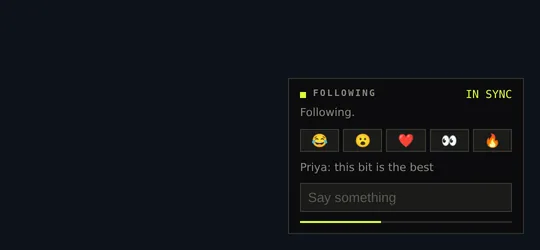
Nobody streams to anybody. Each of you plays your own copy on your own account, so one player is the clock and the other measures its distance from it, a few times a second.
- Under 150ms
- Leave it alone. A correction you can hear is worse than a drift you cannot see.
- 150ms to 2s
- Bend the playback rate between 0.97 and 1.03 until the gap closes. The picture never jumps.
- Over 2s
- Seek, and accept the visible jump. Bending would take longer than anyone’s patience.
Under 150 milliseconds nobody can perceive the difference, so nothing happens — a correction you can hear is worse than a drift you cannot see. In the middle, playback speed bends by a fraction of a percent until the gap closes, and the picture never jumps. Past two seconds, bending would take longer than anyone’s patience, so it seeks and accepts the jump.
The unflattering number, since you would find it out anyway: closing a 1.9-second drift without jumping takes about a minute, because three percent of playback time is the entire budget a nudge has.
And when the clock cannot be measured — a noisy connection, estimates that disagree by more than they should — it says so and declines to correct, rather than showing you a confident number that is wrong.
Bring your own everything
Your account, your subscription, your copy. What crosses the wire is a playhead position a few times a second. No video passes through us, which is the one place this room rhymes with the other one: Lodge never sends the film because sending it would give it away. The Balcony never sends it because it was never ours to send.
Nothing runs until you open a balcony — not when you open Netflix. An extension that starts talking to a server the moment you load a page is not one anybody should trust, including you.
What it does not do
The same discipline as the custody page: these are cheaper to read here than to discover on the night.
Netflix only
One player adapter today. Prime and Disney+ are queued — different services is the most common failure, and a second adapter roughly halves it.
Desktop browser
Permanently. There is no extension API on a television or inside a mobile streaming app, so there is no version of this that runs there.
No conjuring
It cannot make a film appear in a catalogue it is not licensed for. That is a wall, not a bug, and it is the same wall that stops Lodge streaming anybody else’s content.
No recording
Nothing is captured, stored or kept. Not the film, not a frame of it. Only the fact that the two of you watched, and only for the two of you.
No account of ours
You each need your own subscription to whatever you are watching. The Balcony is a clock and a catalogue, not a library.
Not a VPN
It will not pretend either of you is somewhere you are not. Region-shifting breaks the terms of the service you already pay for, and a product whose first instruction is to break your own subscription is not one we are going to build.
Getting it
No card, no trial, no catch. The person you invite never pays and never makes an account.
You each still need your own subscription to whatever you are watching — the Balcony is a clock and a catalogue, not a library.
One click, from the Chrome Web Store
That is the only way this ships. Search it, click Add to Chrome, done — and both of you do exactly that, because an extension only drives the browser it is sitting in.
The listing is not up yet, and the reason is worth saying plainly. The current build asks you for connection details of ours, which is fine for a handful of testers and wrong for everybody else: nobody should have to hold a key to watch a film with someone. We are moving that behind our own service so the extension arrives already knowing where to look. The listing goes up when it does, and this page will say Add to Chrome instead of this paragraph.
Until then it is hands-on rather than self-serve. Ask, and we will get you set up and watching — and tell you the day the one-click version is live.
Streaming availability data by JustWatch, via TMDB. Netflix, Amazon Prime Video, Disney+ and JioHotstar are named as data — no affiliation, no endorsement, no relationship.